Saturday, February 5, 2011

Martyr Sandeep Unnikrishnan's uncle death–Facts that were never reported!

Uncle of Martyr Major Sandeep Unnikrishnan, who attempted self-immolation on Thursday outside Parliament, died on Friday night. One would have expected media to report such a shocking incident as headlines. but it is shocking that media is going overboard to downplay the incident
K Mohanan, a native of Kozhikode in Kerala, poured kerosene on his body and set himself afire outside Gate No 4 of Parliament House near Vijay Chowk. He was admitted to the Lohia Hospital with  98 percent .
Most of the media houses (NDTV, Hindustan Times, Indian Express) report the cause of his drastic action as
"He was disturbed at the death of Sandeep. He wanted to feel the pain Sandeep might have suffered when he was shot at by the terrorists,"
Hindustan Times in their report 26/11 hero’s uncle sets himself afire report
told doctors at the Capital’s Ram Manohar Lohia Hospital that he wanted to “feel the pain that his nephew must have felt”.
NDTV in their report 26/11 hero's uncle sets himself on fire, dies says
Mohanan had told doctors that he was unhappy at the way the victims of the Mumbai attacks were treated by the government. "He was disturbed at the death of Sandeep. He wanted to feel the pain Sandeep might have suffered when he as shot at by the terrorists," the official said.
Indian Express in their report Self immolation: 26/11 martyr Maj Unnikrishnan's uncle dead says
Mohanan had told doctors that he was unhappy at the way the victims of the Mumbai attacks were treated by the government. "He was disturbed at the death of Sandeep. He wanted to feel the pain Sandeep might have suffered when he was shot at by the terrorists," the official said
IBN  in their  report Unnikrishnan's uncle dies after immolation bid goes even further and reported the cause of his drastic action as unknown
Although it was not clear why he took the drastic step, some reports say he was disturbed over his nephew's death. He was apparently also upset with the government's apathy in treating 26/11 victims.
The impression we get from all the media reports is Mr. Mohanan took the drastic action to “feel the pain Sandeep might have suffered when he was shot at by the terrorists” and “upset with the government's apathy in treating 26/11 victims”. Note the operational word is victims of 2611 not perpetuators of 2611!
Media Watch fails to understand how a person who suffered 98% burn would be able to narrate reasons for his drastic action! It is plain that there is much more than what media was reporting. Media Watch after much search stumbled upon following information which sheds new light on the incident
A diary was recovered from Mohanan's belongings which revealed why Mohanan resorted to this extreme step.  The diary read,
“the administrators and representatives of the political parties could not do anything for the victims of the 26/11 attack. It was actually a war against two nations. Wasn’t the decision that was taken by the government on the Kandahar incident a reason for the Mumbai attack?... Anyone can come to India and do anything in India... Indian democracy is a curse for India itself... the enemies are utilizing this... why is the government delaying the introduction of a bill in Parliament against terrorism?.... Democracy should be for the well-being of the nation, and it should not make way for terrorism... Sandu mon (Sandeep Unnikrishnan) you are forgotten every passing day... but I will never forget you.”
Now we know why Govt was overzealous to suppress this information!
It is more shocking to know that Media knew that K. Mohanan was going to commit self immolation, they instead of trying to stop or save him, preferred to record the incident ! According to police
K Mohanan informed a few mediapersons, who parked their OB vans outside Parliament House, before taking the extreme step. Some of them recorded the incident on their cameras without anyone trying to save his life.
Yes you heard it right!  A screen shot of one of alleged videos is below. Media Watch is SHOCKED

Media Watch contacted IBN for clarification on this issue. IBN replied that "by the time journos reached, he had already immolated."
image
Screen Shot
image
image

Martyr Major Sandeep Unnikrishnan’s uncle dead

image

Reading between lines - Rahul supports foreign varsity bill

Media headlines announced Rahul Gandhi supports foreign education bill

Congress general secretary Rahul Gandhi has supported the foreign universities bill at the parliamentary standing committee meeting of the Human Resource Development Ministry on Monday.

So noble indeed. Who will not support such a noble venture of providing quality education to India. Except for you know the usual suspects

There has been opposition to opening up the Indian higher education sector to foreign players by Left parties and BJP.

But wait a sec, why is BJP opposing

BJP MPs are understood to have raised the question of foreign universities not being required to provide reservation for socially and economically backward students. Sources said that BJP MP Kirti Azad argued that keeping foreign universities outside the ambit of reservation would result in keeping children from disadvantaged sections out of these universities.

So if we read between the lines. Is Rahul Gandhi pushing for a Foreign Education Providers' Bill in which foreign universities are not required to provide reservation?

Rahul Gandhi we know of is a strong votary of reservation, atleast in public. Its only last year while interacting with students at National College, Basavanagudi he defended the policy of caste-based reservation in education and employment.

What changed between last year and this year? Also, should the headline not read, Rahul Gandhi supports foreign education bill without reservation?

Friday, February 4, 2011

Let the cat fight begin

No marks for guess, who is she referring to.

Censorship by ‘pay-to-print'– P. Sainath

This was published in The Hindu on February 4, 2011

The year 2010 saw journalists, their associations and unions hold more conferences and seminars on one professional issue than any other. And it wasn't on the Wage Board or the Radia tapes. Hundreds of journalists across the country attended these meetings. Dozens stood up and spoke of their own experiences of the subject. Of how it demoralised them and ruined their profession.

Yet, the main topic of their discussion found no mention in the very newspapers, magazines or television channels they work for. Sometimes, the fact of the meeting being held, perhaps as an event attended by a High Court judge, was reported. But the subject discussed was not. In newspapers and TV channels, choking with stories on corruption, this is the one story you are the least likely to see. The media are their own worst censors when it comes to reporting on ‘Paid News.'

Just before the 2009 Assembly elections in Maharashtra, a large newspaper group in the State brought its editors together for a meeting in Pune. A lively discussion ensued on who would win the elections and the extent to which money power would play a role. Generally, it was agreed, winning a seat in the State legislature would cost Rs. 3 crore to Rs. 5 crore. (That was a huge underestimate, given the expenditures that actually followed.) With 288 seats in the Maharashtra legislature, a party had to win at least 145 in order to rule. This meant an expenditure of between Rs. 435 crore and Rs. 725 crore by the party or front that triumphed. On just the winning candidates.

The editors discussed a few known names of those who had that kind of money power. At this point, the daily's financial managers spoke up. If there's that kind of money being spent, said the cash-box boys, we should get a decent share of it. What, after all, is election expenditure but campaign and propaganda expenses? Detailed plans for ‘pay-to-print' were soon under way in one of the biggest media groups in the State.

Other groups were already ahead of them. A couple of them had already gained on this front during the parliamentary polls. The taste of success in that round had whetted their appetites.

Maharashtra, after all, sees more money than any other State being spent on worse things. Some media groups set themselves targets of 20 to 30 per cent of what they perceived would be the money splurged by the major candidates. Some even assigned cash targets to their different branches. This did not mean forgoing money from the defeated contestants or even the ‘other side' or front. It simply meant that you targeted a lower level of recovery from them. Losing candidates, alas, don't pay up.

Paid news comes in many packages: pre-paid, post-paid and yet-to-be-paid, for instance. There are also deluxe tariffs and aam aadmi tariffs, the former in crores, the latter in lakhs. Sadly, these media groups met, even exceeded, their targets.

But it's not just during elections that paid news or its Euclidian variants occur. The crazy saturation coverage of Davos in some channels was not caused by breathless public interest or media curiosity. It had a lot to do with ‘partnerships' and corporate subsidies the public can't see, and won't be allowed to see. Some channels sent out ‘rules' to their journalists of things that just had to be done. Rules with no particular journalistic rationale at all.

Now we have yet another Group of Ministers, yes, one more, to deal with Paid News. Has the Prime Minister reviewed its composition? It could end up hugely embarrassing to have a member of the GoM whose family owns a major newspaper that could be affected by any inquiry. Or another who, it might turn out, has represented corporate media groups in the past as a lawyer.

“Any news or writing appearing in a media (print or electronic) for a price in cash or kind in consideration” — that is how the Press Council of India (PCI) defined ‘paid news' last year. A lot of this, of course, boils down to advertising disguised as news coverage. In the 2009 elections, powerful media groups connived at the violation of spending limits in the polls by rich candidates and parties. Paid news did more damage to the media's coverage of those polls than any other factor. (Meanwhile, the odium the media earned themselves in the 2009 polls and after, saw this year's Padma awards giving journalism a wide berth. Less Padma, More Lakshmi?)

It is a scam worth more millions than anyone can accurately estimate. Most other institutions of Indian democracy and regulatory structures have tried doing something about it. But in the free media, there was a costly silence. Consider this: the Election Commission of India (ECI) has tried hard to curb the menace with a strong crackdown that actually saw candidates in the recent Bihar elections pulled up in over 87 instances of ‘paid news.' The ECI has also drawn up new guidelines and rules to help its officers spot and stamp out what is essentially a media management-driven racket. It now has a special division dealing with money power and paid news. And it has taken up a major case: of former Maharashtra Chief Minister Ashok Chavan's huge media blitz during the 2009 election campaign.

Almost nothing of this has been reported in the media, barring The Hindu and a couple of other publications. The hearings in the Chavan case have been fascinating too — with near-zero coverage. The ECI, normally treated with great respect by the media, has seen many of its initiatives on the ‘paid news' front simply being blanked out. So the public gets to know very little about how alive the ‘paid news' issue is. Will the case get bogged down in challenges of jurisdiction and in the courts, or will we see a decisive result, given the firmness of this ECI? As news, or as an issue, it ought to fascinate the media. But there is silence because, while Mr. Chavan stands accused, it is the media who are on trial.

Or take Parliament. It saw an astonishing consensus on this subject. The issue came up through a vital calling attention motion moved by Sitaram Yechury of the CPI(M), a clinical dissection of the problem by Arun Jaitley of the BJP, and with members from all parties in total agreement that ‘paid news' was disastrous for democracy. Across the spectrum, MPs demanded an end to the practice. Not a word on this Parliament debate appeared in most of the media. Much earlier, the country's Vice-President had detailed the ‘double jeopardy' that paid news placed Indian democracy in. One, it wrecked the concept of a fair and free press. Two, it undermined the democratic electoral process of the nation. Later, President Pratibha Patil voiced her concern over the damage this was doing to free media.

Or look at the Securities and Exchange Board of India. SEBI was disturbed by what ‘private treaties' between the media and private corporations were doing to news. (These ‘treaties' opened the floodgates for paid news.) It felt that such backdoor deals where corporates pay media companies in shares for advertising, plus other favourable coverage, could mislead investors. They “may give rise to conflicts of interest and may, therefore, result in dilution of the independence of the press vis-à-vis the nature and content of the news/editorials in the media ...” SEBI, therefore, got the PCI to make mandatory the disclosure of any such links. It sought to ensure that such disclosure would have to be made in any “news report/article/editorial in newspapers/television relating to the company in which the media group holds such stake.” Following this, one of our largest dailies carried a tiny line below a piece linked to the Lavasa private city project in which it admitted to having a minor stake. In the kind of font size that had Sherlock Holmes reading newspapers with a magnifying glass.

The PCI set up a two-member sub-committee, which produced a devastating 71-page report on Paid News (see The Hindu, April 22 and August 5, 2010). Buckling under pressure from powerful media owners, the PCI then betrayed its own ideals and the public by suppressing its report. However, that report is freely available online, even if banished from the PCI's website.

So the ECI, Parliament, SEBI and top political leaders have all contributed to the fight against the slaughter of honest journalism. Even the spineless PCI did so, before deserting ship. But in the media there is near-total silence. True, there are the exceptions. And the fact that all those journalists went public at those meetings shows how deep their resentment runs. But institutionally, the media's failure is huge and, if not reversed, will extract a terrible price. The corporate media have censored the Paid News story, browbeaten their own journalists and cheated the public of information it has every right and need to know.

Thursday, February 3, 2011

None of Media Houses reported this sad and shocking news as Headline

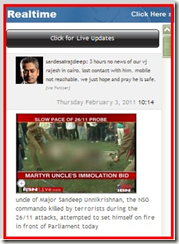
As media in India is busy reporting Egypt and more fashionable news, Uncle of Maj Sandeep Unnikrishnan has attempted to immolate himself. Reports suggest he was upset by slow pace of 26/11 Probe.  He has been admitted to hospital with 70% burns.

Media Watch prays for his fast recovery and shares his disappointment and frustration. It is more disappointing that Media which should be showing this as headline has totally blacked this out from their main news!

TOI which has even space to publish news like Kangna's secret tattoo for beau in front page does not have space for this news in their front page. 

IBN has published it in their sidebar


Please let media know your outrage!

The untold facts about “Harsher Report”on the attacks on churches

Last week finally Justice B.K. Somasekhara Commission of Inquiry appointed by Govt. of Karnataka to inquire into the incidents of attack on Christian places of worship in Dakshina Kannada submitted his much awaited report. During the course of Inquiry, the Commission received 1019 petitions and examined 754 witnesses spread over a period of 300 days of judicial sittings. 34 Advocates representing various concerned sections of the society including the Govt. presented their case before the commission and the final arguments were heard over a period of 53 sittings. As many as 2437 documents were marked by the Commission as exhibits in addition to 34 Material Objects in the form of Electronic storage documents.
According to the commission findings
There is no basis to the apprehension of the Christian petitioners that politicians, BJP, mainstream Sangh Parivar and state government directly or indirectly are involved in the attacks
Justice B.K. Somasekhara Commission of Inquiry may have given a clean chit to Sangh Parivar but it seems that NDTV is not willing to rest the matter. NDTV in their news article Karnataka church attack: A harsher report digs up another report by a former judge of the Karnataka High Court Justice MF Saldanha who conducted parallel independent inquiry. According to Justice MF Saldanha’s “independent inquiry”
state police was involved in the attacks, and that the then Bajrang Dal state leader, Mahendra Kumar, says he was asked to carry out the attacks by government representatives.
Justice MF Saldanha is within his rights to conduct an independent inquiry. But NDTV should have been more responsible while reporting this news. It seems that knowingly or unknowingly NDTV missed out some salient facts about this news. 
NDTV failed to inform that Justice Michael F. Saldanha is president of the Catholic Association of South Kanara! Yes you heard it right… Justice Michael F. Saldanha is president of the Catholic Association of South Kanara (a district in Karnataka also known as Dakshina Kannada), Dakshina Kannada is the place where violent incidents had taken place! It is difficult to believe that a Inquiry conducted by  president of the Catholic Association of South Kanara would be impartial. In fact, Justice Saldanha himself says
any commission or inquiry set up by the government to investigate its own actions in unlikely to be impartial.
Wont the same logic be applicable to Justice  Michael F. Saldanha  also?
Also, Justice Michael F. Saldanha has always been harsh critic of BJP govt in Karnataka. He was among Christian leaders who opposed the state government passing a bill aiming to ban cow slaughter as
the move targets food habits of religious minorities
International Institute for Religious Freedom in a report India: Anti-Christian Violence Soars in Karnataka reports Justice Michael F. Saldanha views
Brahmins from Udupi district and Mangalore city have played a leading role in Karnataka's Hindutva movement. This is unsurprising, as Hindu nationalism is driven primarily by Brahmins desperate to preserve caste privilege. As those at the very top of the Hindu caste system, powerful Brahmins have the most to lose from any spread of Christian egalitarianism. So they are compelled to fight Christianity -- unless of course, the Holy Spirit transforms and humbles their hearts
It is shocking that a Justice of High Court could hold such views!

In view of the above, NDTV should introspect whether a inquiry report from Justice Michael F. Saldanha would be impartial or not? If it cant be impartial wont NDTV be misleading its viewers